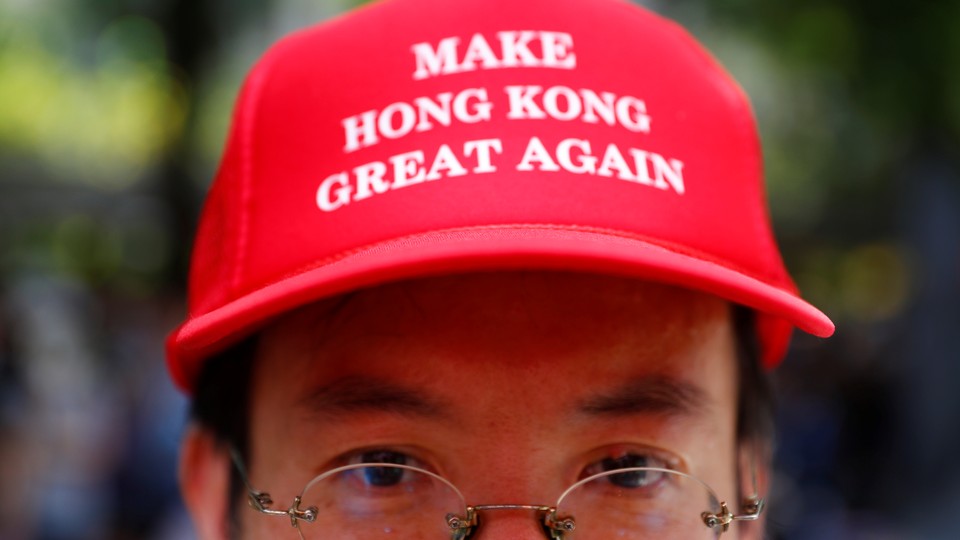
Make Hong Kong Great Again Hat
Trump Is a 'Necessary Evil' for Some
Despite his own assault on democratic norms, the president is lauded in parts of Asia for his hawkishness toward China.
To speak to Wan Mentum, the host of a YouTube politics show, is to hear echoes of American conservative radio: An "invasion" of immigrants is crossing the border, filling public housing and sapping upward limited authorities resource, he told me; the coronavirus is a "Frankenstein" superbug weaponized in a Chinese lab; and President Donald Trump's "Rambo way" of leadership has finally called out China for its hostilities. When Trump was diagnosed with COVID-19, Chin took to Facebook to wish him "a speedy recovery from the mild flu," parroting the president's own downplaying of the virus'due south severity.
Mentum isn't an American shock jock, though. In fact, he doesn't even live in the United States. He is, instead, an early and prominent advocate of Hong Kong's prodemocracy movement: His 2011 book, On the Hong Kong City-State, was a formative text for the localist movement, which seeks to promote and protect Hong Kong's identity and fashion of life, divide from that of mainland People's republic of china. Chin, a former professor, peppered his opinions with historical references to ancient Chinese dynasties and arcane tidbits from folk tales. The walls of his part are lined with Chinese and Buddhist shrines, ornately carved out of dark wood. Every bit he spoke, a adult female entered and lit a small bunch of incense, the fragrant smoke twisting up toward a red "Make Hong Kong Great Again" T-shirt hanging near the door.
Chin is also an unapologetic cheerleader for Trump, whom he calls a "hero," and he is far from alone. This city lies at the forefront of the global fight for democracy, a place where protesters take for more than a year stood against Beijing'south attack on Hong Kong's autonomy, gratuitous press, and liberal institutions. Yet support for the president—whose ain assault on democratic norms, gushing over the Tiananmen Square massacre, on-over again, off-over again praise of Chinese President Xi Jinping, initial lukewarm support of Hong Kong's protestation motility, and self-admitted ho-hum-rolling of sanctions over Xinjiang's mass-detention camps in favor of a trade deal—remains stronger in some quarters than for his Democratic rival, Joe Biden.
These feelings are non unique to Hong Kong. Though reviled in much of Europe for his rhetoric about migrants, his questioning of NATO, and his friendliness toward Russian President Vladimir Putin, Trump has earned credit in parts of Asia for his hawkishness toward Beijing, which supporters debate has non just shifted Washington's ain position, but has also emboldened other countries around the globe.
In Vietnam, where anti-Chinese sentiment is rife, a song pro-Trump faction cheered his first, chaotic debate performance on social media. Republicans' staunch anti-Communist positions have long found an accepting audience amid Vietnamese Americans. Elsewhere in Southeast Asia, Trump has seen support in the Philippines—a land that has a Trump-similar leader (albeit i who has openly courted China)—as accept members of that country'southward diaspora in America. Indeed, Vietnam and the Philippines, both countries that have seen a more hostile position from Beijing in the South China Sea, are two of a small number of countries whose people were positive on Trump and his policies, according to polling conducted by the Pew Enquiry Center in 2017. Deeper ties with Taiwan, including a flurry of weapons sales, likewise as a distrust of Biden, have also bolstered Trump'southward standing in Taiwan, making him the favorite there. At that place are fifty-fifty a number of Chinese liberal intellectuals who openly support the president, with "absolute, heartfelt adoration, admiration, and idolization," Yao Lin, a student at Yale Law School, wrote in a May newspaper exploring the topic. Many of them accept undergone "a Trumpian metamorphosis," he wrote, noting that the phenomenon is "curious because it defies the conventional (and user-friendly) narrative in which China'southward pro-reform, pro-liberal-republic, pro-universal-values intellectuals fight relentlessly against injustice, authoritarianism and narrow-minded nationalism."
In Hong Kong, it is unclear just how widespread back up of Trump is. Polling conducted for Newsweek in July by Redfield & Wilton Strategies of 1,000 Hong Kongers found that respondents narrowly favored Trump to win the 2020 election, by a margin of 36 per centum to 33 percent for Biden. A YouGov poll this month, however, plant Biden having a slight edge over Trump. Chin and his viewers are in many means emblematic of the metropolis's Trump-supporting bloc. Though he has never reached the international recognition obtained by activists like Joshua Wong, Mentum retains a considerable following of devoted adherents and a sizable online presence. Following Trump'due south ballot in 2016, Chin published The Trump Strategy, a book that analyzed the president's dealings with China. Last year, when enormous protests erupted in Hong Kong, Chin urged his supporters to carry Trump flags and vesture Trump gear to protests every bit punitive legislation targeting Hong Kong was making its mode through Washington, playing to the president's oversize ego and hoping to "grab his eye." Chin told me he was drawn to Trump's rhetoric on the economic gamble China poses to the world, and used Hong Kong as an instance of what he saw as state capture accomplished through Chinese state-owned enterprises—snatching up newspapers and swaths of existent estate since the city returned to Chinese dominion in 1997—as the type of threat Trump was sounding the alarm against.
Dozens heeded the call, creating scenes that looked akin to Trump rallies in the U.S.: American flags flapping in the hot Hong Kong breeze held aloft by local protesters in MAGA hats, the "Star-Spangled Banner" sometimes blaring from portable speakers in the background. Back up from both Democrats and Republicans in Washington was stiff, but some of the GOP's loudest voices trumpeted the images as proof that America's position in the globe every bit a beacon of democracy remained unscathed. Visits by Republican Senators Ted Cruz and Josh Hawley during protests last yr helped to further eternalize the conventionalities among some demonstrators that Republicans were incomparably more pro–Hong Kong than their Democrat counterparts, despite the fact that there was potent bipartisan support for the city in Washington. The scenes infuriated Hong Kong'southward pro-Beijing faction, calculation fuel to the unfounded conspiracy theory that the protesters were receiving clandestine aid from abroad.
Much of the support for Trump here has its genesis in the belief that during Barack Obama'due south administration, warnings from Hong Kong about Prc'southward growing accomplish went more often than not unheeded in Washington. Some see this trend extending further back, citing Bill Clinton'southward efforts to bring the country into the World Merchandise System and the policies of other Democratic presidents before him (even though it was Richard Nixon, a Republican, who first established ties with the Communist government in Beijing). Starting in the mid-2000s, Alan Leong, chairman of the Civic Party, Hong Kong'south 2nd-largest prodemocracy grouping, began traveling to Washington and European capitals, conveying a bulletin of alarm arguing, he told me, "If you go along to turn a bullheaded eye to what … China had been doing, then very soon you would finish up facing a reality of having nurtured a monster that you couldn't control and yous would be admittedly at the monster's mercy." In many places, including Washington, Leong said, he found an audience that was largely uninterested in what he had to say.
Leong and others cite the Hong Kong Human Rights and Commonwealth Act, introduced in 2014 past a bipartisan grouping of legislators including Republican Senator Marco Rubio, simply not passed until last year, as proof of Trump's commitment to Hong Kong. But Trump was originally noncommittal on the bill and said he might veto information technology, before eventually signing it. The human action passed near unanimously in Congress, one of the few pieces of legislation with clear bipartisan support amid bitter divisions on Capitol Hill concluding yr. "My feel is that Hong Kong is even more partisan when information technology comes to U.Due south. politics than Washington is when it comes to dealing with Hong Kong," Jeffrey Ngo, a prominent Hong Kong activist and doctoral student at Georgetown University, told me. Washington also imposed sanctions on Carrie Lam, Hong Kong'southward main executive, and 10 other officials in August, to celebratory glee from many in the city. More Hong Kong sanctions are being considered, a congressional Democratic aide told me recently, speaking on condition of anonymity because they were non authorized to speak to the media. In that location are too a number of pieces of pending legislation aimed at aiding people fleeing Hong Kong for the U.South., which have back up from both Republicans and Democrats.
While Trump supporters see him every bit the driving strength backside the change in U.S. policy toward Hong Kong, this ignores, experts told me, the reality of Beijing'due south tightening agree on the metropolis, which forced recalculations for Washington. Terminal year's protests fabricated the situation "radically different" than when Obama was in office, Elizabeth Economy, a senior boyfriend for Red china studies at the Quango on Foreign Relations, told me. U.S. policy toward China more than broadly had two sides, she said: One focused on the issues Trump cared about, namely trade, while the other included "everything else," such as human rights and broader Indo-Pacific strategy, which is handled past Congress and foreign-policy professionals. "The administration and Congress have been tough on Mainland china," Economy said, "but it is because of the leadership vacuum that the president has created, non considering he is a stiff leader with a strategic vision for the U.S.-China relationship or the U.Southward. in the Asia Pacific." Indeed, recent reporting past The Wall Street Periodical establish that Trump was, until recently, often belongings back a harder line on People's republic of china.
Trump'south detractors here contend that the president cares niggling well-nigh Hong Kong, that the United States sees information technology as nothing more than a geopolitical football to exist punted between Washington and Beijing, and that, ultimately, the U.Southward. would not help the cause of the prodemocracy movement. As Black Lives Matter protests grew in the U.S. after the killing of George Floyd, many of the Republicans who were most vocal in their back up of Hong Kong were loudest in their condemnations, drawing charges of hypocrisy. Discussing the White House's handling of Hong Kong–related legislation, Trump'southward nonreassuring responses when asked nigh the city, as well as revelations by former National Security Adviser John Bolton over Trump's views on the protests, confirmed some of these fears.
This nuance seems to matter picayune. An stance piece in Apple Daily, a prodemocracy newspaper, declared final month following the commencement presidential contend that "a vote for Trump is not only for the Americans' own interests, but it is also one that is for the survival of the complimentary world." Writing in the aforementioned paper days after, Lee Yee, a veteran columnist and political commentator, decried the Democrats dating dorsum to Harry S. Truman for continuously bending to China'south will, complaining that there is a "leftist ideology permeated in Western academia and journalism." The newspaper's founder, Jimmy Lai, who was arrested in August nether suspicion of violating a broad new national-security police force imposed on Hong Kong by Beijing, is an outspoken Trump supporter. "He plays hardball and he is a man of his word, and he is really powerful in the way he deals with dictators," Lai told the Hong Kong Free Press. (Trump himself admitted to having an affinity for dictators and autocratic leaders in an interview with the announcer Bob Woodward.) Recently, Lai has focused on alleged transgressions by Biden'due south son, Hunter, whose business dealings when his father was vice president have become the target of attacks in the final days earlier the election. In a bizarre incident, an Apple tree Daily official reportedly helped to finance a dossier on Hunter, which was peddled past a fictitious annotator. "The way mainstream media covers upwardly [the] Hunter Biden scandal epitomizes what America will become, if Biden wins—a shield of hypocrisy, a country out of affect with reality," he posted on Twitter.
This support for Trump is mirrored in parts of the prodemocracy movement by a deep distrust of Biden due in large part to his time serving under Obama. Many here believe that Biden "could well sell out Hong Kong," Victoria Tin-bor Hui, an acquaintance professor of political scientific discipline at the University of Notre Dame, told me.
In his wildly popular videos, Stormtrooper, a pseudonymous YouTuber who has amassed a subscriber base of more than 140,000 people and racked up xiv million views, champions Trump as a savior for Hong Kong and disparages Biden, sometimes drifting into conspiratorial fringes of claims confronting the former vice president and his son. Much of the U.S. media favored Biden, he told me, adding that his own diet of news came from outlets such as The Epoch Times, a newspaper aligned with the Falun Gong spiritual motion, which has expanded aggressively in recent years and faced allegations of spreading right-wing misinformation.
Sitting at a table covered with recording equipment in a studio whose walls were plastered with fan fine art, protest posters, and Star Wars memorabilia, Stormtrooper told me he was unconcerned with Trump'southward other comments and actions outside his tough talk on China and moves confronting the Hong Kong regime. Underpinning his argument was a conventionalities that American republic provided sufficient guardrails to protect confronting Trump'due south excesses. Compared to Cathay'south leadership, he argued, zero Trump could do or say would exist about as bad.
The president's attacks on the media had not resulted in any existent damage, he said, plus, "in China the press volition be locked upwardly or even worse." Trump's racism was the same as Biden'southward, he continued, citing Biden's comments in May that people "ain't Black" if they vote for Trump. The president was all the same standing after the investigation into his connections to Russian federation, proof that he had done nothing illegal. Trump'southward just wrongdoing was paying very fiddling in taxes, but even that was "normal," Stormtrooper said—"in Hong Kong, no rich people pay taxation." A few days after we spoke, nearly 7,000 people tuned in to his YouTube channel for live translation into Cantonese of the second presidential argue.
Chin, the political commentator, said Trump had created irreversible momentum against Prc, but he yet acknowledged the president'south contradictions. He is "a good leader, simply not a democratic leader," he told me. During his time in office, Trump had been "violating a lot of good practise of commonwealth," he added, merely, in exchange for taking on People's republic of china, this was a "necessary evil."
bongiornoinct1938.blogspot.com
Source: https://www.theatlantic.com/international/archive/2020/10/democracy-activists-who-love-trump/616891/
0 Response to "Make Hong Kong Great Again Hat"
Post a Comment